
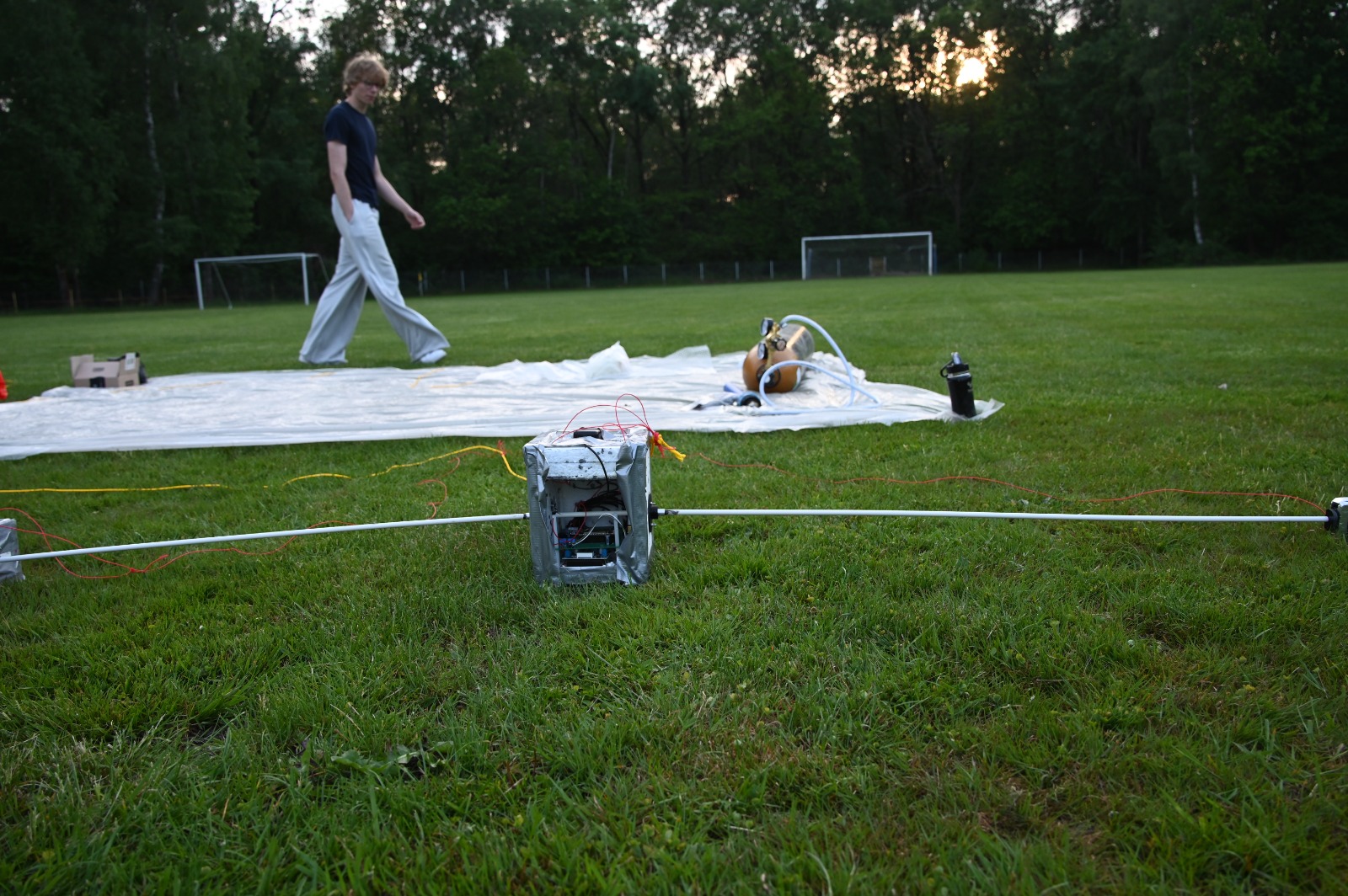
Sunday, May 31st, is already behind us. What a day it was! Not only did the weather cooperate, but so did the team (I certainly wasn’t expecting so many people). I also can’t say that everything went according to plan. You could say it was a day filled with hope, successes, and painful disappointments. But let’s start from the beginning.


We arrived in the village of Łęki, where the flight was scheduled to take place, at around 5:40 PM, giving us roughly two hours to prepare for launch. Meanwhile, more and more people arrived to witness the event, including several local residents. Overall, I was very positively surprised as I wasn’t expecting such an audience. In fact, I wasn’t expecting any audience at all, so this was a very pleasant surprise. I’d like to take this opportunity to thank everyone who came that day to be part of the event.


At around 7:15 PM, we began filling the balloon with helium and preparing the payload. I’d also like to extend my sincere thanks to everyone who helped directly with the balloon and to those who were filming and photographing the entire event. The balloon was launched at approximately 7:50 PM. The ascent initially went according to plan. However, the winds had changed, which altered the predicted flight path and landing area – an important detail that will become relevant later.


The LoRa module began transmitting correctly right from the start and was sending telemetry packets every 60 seconds. Therefore, shortly after launch, we quickly packed up the equipment and started following the payload by cars. For the next hour, everything went very well. The payload climbed as expected, the signal strength remained satisfactory, and we successfully received every single packet transmitted by the stratospheric nacelle.
The problems started at an altitude of approximately 10.5 km, around 9:00 PM. Suddenly, a message arrived indicating that the transmitter module had restarted and that an SD card initialization error had occurred. Similar error messages continued for about three minutes before the payload… fell silent. From that moment on, a new series of failures began.


At that point, all hope rested on the backup recovery system which was a satellite tracker. Unfortunately, it turned out to be quite a disappointment. The last signal was received at approximately 5,600 meters above sea level at 9:15 PM, and sadly, that was the final message. During the entire flight, we received only six position reports, each spaced five minutes apart.
If you’ve made it this far in the story, you may remember that I mentioned the weather earlier. As it turned out, the winds changed direction that day, rendering our previous landing simulations useless.


The good news was that the payload was flying eastward, toward less populated areas. The bad news? Instead of heading northeast, it flew southeast, directly toward the heavily forested and mountainous regions around Gorlice and further into Magurski National Park… As you can imagine, losing communication while the payload is descending into dense forests and mountains is far from ideal when it comes to recovery efforts.
The first search operation took place on the same day as the launch and lasted until 2:00 AM the following morning. Equipped with headlamps, we searched the area identified as the most likely landing zone. Unfortunately, we found nothing, and after returning home around 5:00 AM, we had to accept defeat for the time being.


The next day, we resumed the search in daylight. Here, I’d like to give special thanks to my friend Mateusz Windak for providing and operating a drone. We searched the area where the last message had been received and later moved to several meadows located within the projected landing zone. Unfortunately, after several hours of drone-assisted searching, the payload remained missing.
The next recovery attempt will take place after… returning from Spain. Yes, on June 2nd, together with two friends, I traveled to Spain to search for potential launch sites for the August solar eclipse mission. Three days of sleeping in a car, eating pasta cooked on a camping stove, and washing from water bottles. All in the name of science! Of course, I’ll be sharing photos from the potential launch locations soon.


So what comes next after the failure of this flight? First of all, was it really a failure? I think only partially. Whenever we pursue ambitious goals, complete success isn’t always guaranteed. Sometimes you need to take one step back in order to take two large steps forward. Every major endeavor in human history, whether the Apollo program, groundbreaking engineering projects, or even student projects all of them have experienced setbacks. But that doesn’t mean we should give up on our plans. It doesn’t mean we should give up on our dreams. Once again, I’d like to thank everyone who supported me in any way possible. I’m not giving up, and I fully intend to continue this project.


This flight provided valuable lessons that will help improve future missions. Therefore, after returning from Spain and completing the search for suitable eclipse launch sites, I will resume both the search for the lost payload and further development of the project based on the lessons learned from Sunday’s flight. Before the eclipse, I plan to conduct several more test flights to ensure that everything is fully prepared for August.
Stay tuned!