
Pre-flight preparations
That day, I was obviously stressed, but at the same time very excited about what was about to happen. We arrived at the launch site with two good friends shortly after 11 AM (we had arrived in Toruń the night before and stayed there).
What we saw were laid-out cords, helium tanks neatly arranged, and balloons waiting to be filled. The overall organization of the event was very professional, and preparations for “zero hour” were running smoothly.
Once the balloons were filled, the last step was to attach the payloads and begin the countdown.
Stratosphere – here I come 😊


Launch and flight of the payload
The launch took place at 12:18 PM from the parking of the Centrum Nowoczesności Młyn Wiedzy.
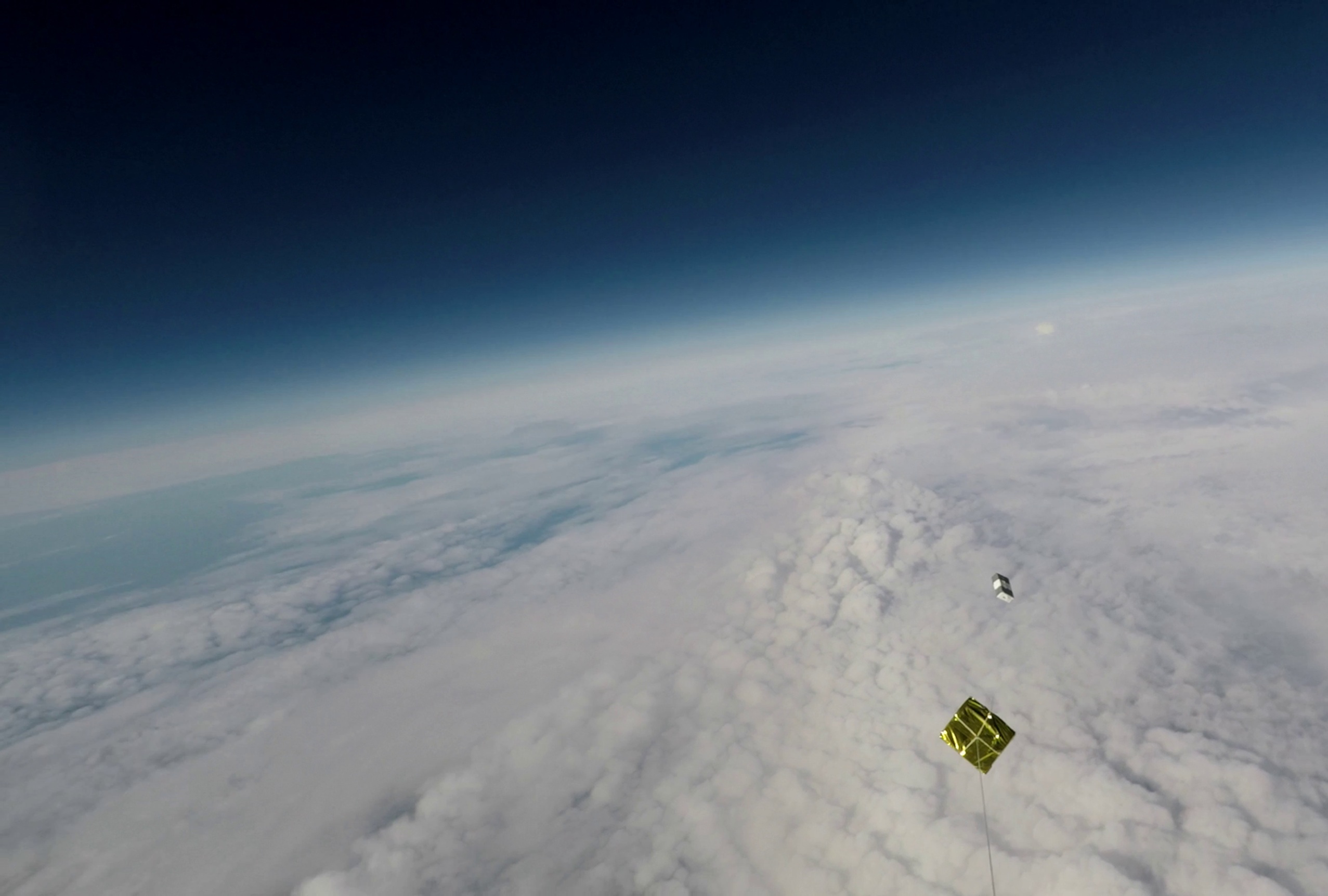
My payload was attached beneath another payload that was also flying that day. To be precise, there were five or six payloads tied to the one balloon. This, as it turned out later, had a significant impact on both the ascent rate and the distance from the launch site where the payload landed.
The entire setup was attached to the helium-filled balloon. The payload also included a parachute, designed to slow down the descent after the balloon burst and ensure a safe landing.
The ascent lasted quite a long time for this type of mission – about 70 minutes. The balloon burst at an altitude of around 20 km above sea level, which is actually relatively low compared to what these types of balloons can typically achieve.
This was most likely caused by the combined weight of the payloads (exceeding 5 kg) and possibly a defect in the balloon that led to its premature rupture. Supporting this theory is the fact that other balloons launched that day reached much higher altitudes – one of them definitely exceeded 30 km.
Interestingly, the balloon didn’t explode violently but rather tore, creating a relatively small opening through which the helium escaped.


Landing and payload recovery
After the balloon envelope tore (which is probably the more accurate description), the descent began using the parachute. It lasted a bit over 30 minutes and ended with a successful landing somewhere near Ostróda.


This means the payload traveled approximately 140 km horizontally. In other words, for every 1 km of vertical movement, it covered about 7 km horizontally – indicating strong winds that day. As mentioned earlier, the relatively large mass of the system also contributed to a slower ascent.
The payload was recovered a few hours after landing. LEDs and a buzzer turned out to be extremely helpful, as it was already getting dark by the time we reached the landing area, and visibility was limited. That said, the LEDs I used (5 mm) were definitely too small.

After returning near Toruń and inserting the SD card into my laptop, it turned out that all the data collected during the flight had been successfully recorded – more on that in the final part of the STAN ONE PROJECT article 😊